Literary historians maintain that women have never contributed significantly to the German drama. Facts, however, point clearly to the opposite. Indeed, the first known German dramatist (10th century) was a woman! Two major causes for the lack of historic recognition are: (a) prejudice that women are incapable of good dramatic production, (b) underrating of plays because professional critics—traditionally men—have used male psychology as the criterion for judging female characters in plays by women. A revaluation of women’s contributions to drama is imperative.
(Scholtz Novak 1972, 47)
When the German-born American scholar of German literature Sigrid Scholtz Novak issued her call for greater recognition of women playwrights in the early 1970s, she was responding to a literary historiography that had either largely overlooked women’s extensive dramatic production or fundamentally questioned its aesthetic and historical significance. More than five decades later, scholarly engagement with women playwrights has expanded considerably. Nevertheless, the problem of accessibility identified by Scholtz Novak remains unresolved. Many plays by women are still available only in historical print editions, are dispersed across libraries and archives, or are absent from the digital text collections that increasingly underpin literary-historical scholarship and computational research.
Within the Digital Humanities, accessibility entails more than the provision of a digital surrogate. For literary works to be discoverable, systematically analysable, and reusable across different research contexts, they must be represented in structured and interoperable formats, documented with reliable metadata, and integrated into sustainable research infrastructures. Digital corpora therefore are not neutral representations of literary history. Their composition reflects historical processes of publication, preservation, canon formation, scholarly reception, selection, and digitisation. As a result, works by women remain substantially underrepresented in many digital collections.
Against this background, the University of Rostock will host the hackathon Women Playwrights in Digital Corpora from 7 to 9 September 2026. The event will address both the digital representation and computational analysis of plays by women, with particular attention to their integration into the DraCor research infrastructure.
DraCor (short for Drama Corpora) is an open and multilingual research infrastructure for the computational study of drama from antiquity to the twentieth century. Its corpora are encoded according to the guidelines of the Text Encoding Initiative (TEI) and made available through a web interface and an application programming interface (API). DraCor currently comprises 33 drama corpora containing more than 4,000 annotated full-text plays in 24 languages. As a community-driven project committed to open-science principles, it supports a broad international research landscape in computational drama analysis and theatre history.
About the Hackathon
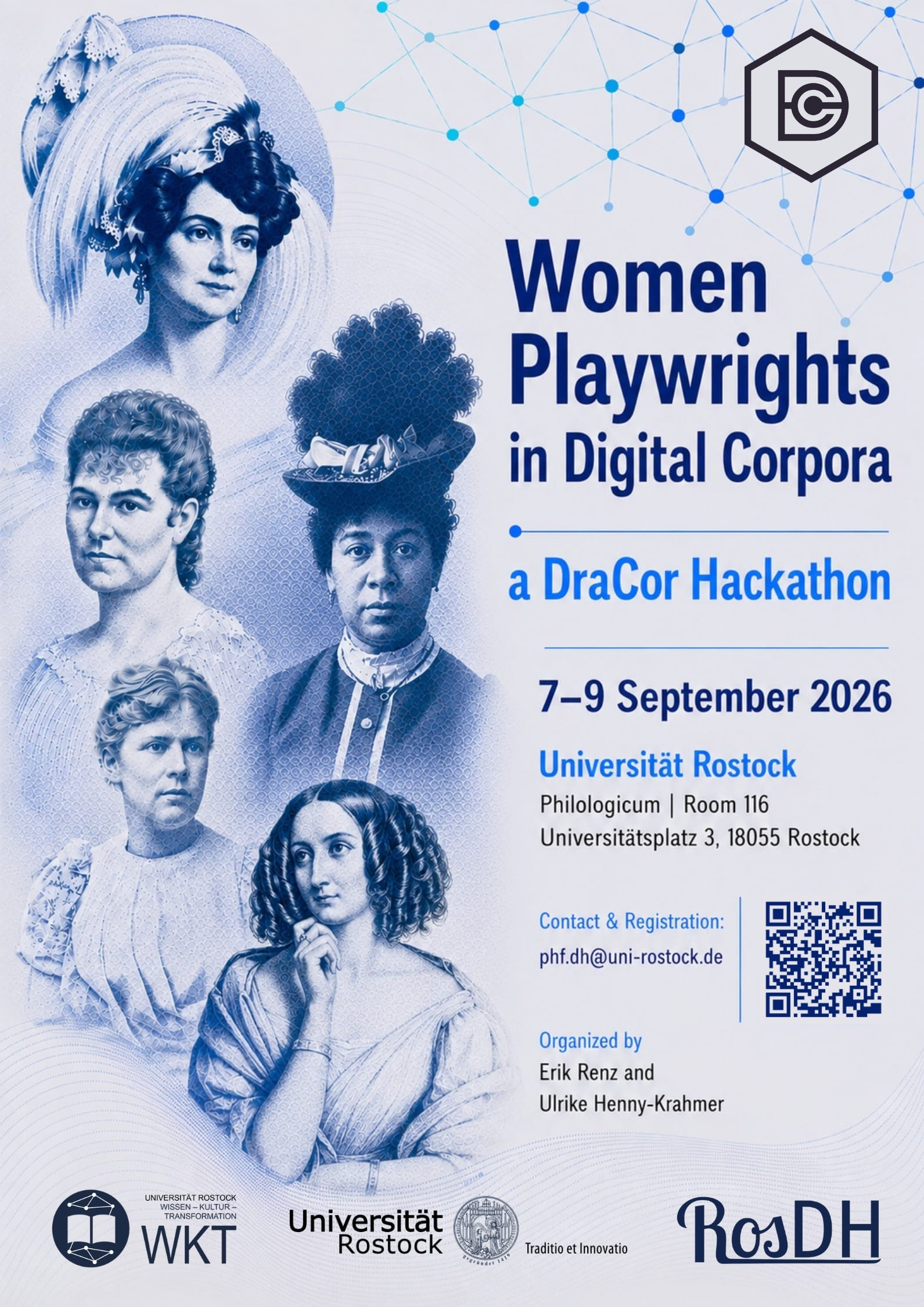
The hackathon will take place in Rostock from 7 to 9 September 2026. Hosted by the Professorship for Digital Humanities at the University of Rostock, the three-day event will bring together researchers from computational literary studies, cultural analytics, digital scholarly editing, theatre studies, and related fields.
The program will combine introductory training sessions on encoding dramatic texts in TEI and working with DraCor data with scholarly presentations, collaborative working sessions, and discussion formats. During the working sessions, participants may either pursue projects of their own or contribute to prepared thematic work packages.
Program
Monday, 7 September 2026
| 13:00–13:15 | Welcome and Introduction |
| 13:15–14:45 | Beginners’ Training Session I: From Dramatic Text to DraCor TEI Tutors: Julia Jennifer Beine & Aşina A. Yıldız (both Würzburg) |
| 14:45–15:15 | Coffee Break |
| 15:15–16:45 | Beginners’ Training Session II: Analyses with DraCor Data Tutor: Frank Fischer (Berlin) |
| 16:45–17:15 | Coffee Break |
| 17:15–18:45 Hybrid session On-site and online No registration required. |
Keynote Speaker: Cristian A. Aravena (Santiago de Chile) Latin American Women Playwrights: The Work of Isidora Aguirre (1919–2011) |
| 19:30 | Informal Dinner at L’Osteria Rostock |
Tuesday, 8 September 2026
| 09:00–10:30 Hybrid session On-site and online No registration required. |
State of the Art: Women Playwrights in Digital Corpora Speaker 1: Anna Axtner-Borsutzky (Munich) (Lost in Archives) Speaker 2: Lou Klappenbach (Berlin) (Gender & Data) Speaker 3: Marius Hug (Berlin) (Text+ / Collections) |
| 10:30–11:00 | Coffee Break |
| 11:00–12:30 | Collaborative Working Session I |
| 12:30–13:30 | Lunch Break |
| 13:30–15:00 | Collaborative Working Session II |
| 15:00–15:30 | Coffee Break |
| 15:30–17:00 | Battle of the Plays World Championship 2026 Moderators: Frank Fischer & Antonio Rojas Castro (both Berlin) |
Wednesday, 9 September 2026
| 09:00–10:30 | Collaborative Working Session III |
| 10:30–11:00 | Coffee Break |
| 11:00–12:00 | Round Table Discussion + Closing Remarks |
The hackathon is conceived as an open and collaborative environment for exploring methodological and practical questions relating to digital drama analysis, text encoding, corpus development, metadata modelling, and data enrichment. Rather than focusing exclusively on completed research results, the event invites participants to develop and test new approaches, exchange expertise, and collaborate on concrete textual and data-based materials. Possible topics may include:
- the encoding, documentation, and enrichment of plays by women;
- the integration of new plays into existing or newly established DraCor corpora;
- the digital modelling and analysis of characters and gendered patterns of representation;
- the computational analysis of character networks, speech distribution, scene structures, and stage directions;
- comparative analyses across languages, historical periods, dramatic genres, and theatrical traditions;
- the reconstruction of reception and transmission networks through authority data and linked open data;
- the development of methods for linking plays, authors, characters, performances, translations, adaptations, and other forms of reception.
The event is open both to participants with previous experience of DraCor or TEI and to interested newcomers. No prior technical knowledge is required.
Registration
The event will take place on site at the University of Rostock. Participation is free of charge and limited to 35 participants. To register, please send an email to phf.dh@uni-rostock.de. When registering, please indicate whether you would also like to attend either or both of the following accompanying events:
- Monday, 7 September 2026, from 7:30 p.m.: Informal dinner at L’Osteria Rostock. Participants are responsible for covering their own expenses.
- Tuesday, 8 September 2026, 3:30–5:00 p.m.: Battle of the Plays World Championship 2026
While the event will generally take place on site, the Keynote on Monday, 7 September, and the session “State of the Art: Women Playwrights in Digital Corpora” on Tuesday, 8 September, will be held in a hybrid format. Interested participants may attend either program item in person or online. No registration is required for either program point.
Venue
Seminar Rooms 105 and 116
Philologicum
Universitätsplatz 3
18055 Rostock
Germany
Online participation via Zoom
Zoom-Link: https://uni-rostock-de.zoom-x.de/j/68841161435
Meeting-ID: 688 4116 1435
Organisers: Erik Renz and Ulrike Henny-Krahmer
Contact: phf.dh@uni-rostock.de
The event is organised with the support of the team of the Professorship for Digital Humanities at the University of Rostock. It forms part of the activities of the Rostock Working Group for Digital Humanities (RosDH) and is funded by the Department “Wissen – Kultur – Transformation” of the Interdisciplinary Faculty and by the Faculty of Humanities at the University of Rostock.
Kommentar schreiben